Appliance repair · Fairfax County, VA
Refrigerator Not Cooling: Causes and What to Check
Jem repairs refrigerators, washers, dryers, ovens and dishwashers at your home across Fairfax County. Call and he'll get yours fixed.
- 6 years hands-on
- $90 diagnostic
- 90-day parts & labor warranty
- Mon–Sat 8am–8pm
Quick answer
A refrigerator that is not cooling usually has one of five faults: a failed evaporator fan, a defrost system that let frost block the airflow, dirty or blocked condenser coils, a failed condenser fan or start relay, or a weak compressor. The first three are routine repairs. Check power, settings and door seal, then call (571) 306-9390.
Updated 2026-11-12 · Serving Fairfax County, VA
This page is the diagnostic half of our refrigerator repair section. It explains why a refrigerator stops cooling, what you can rule out yourself without tools, and how a technician confirms the real cause. Nothing here involves opening sealed parts or handling refrigerant.
Is it safe to check anything yourself?
Yes, as long as you stay with the basics: power, settings, airflow and door seals. Unplug the refrigerator before touching anything behind the lower front grille or the rear panel. Do not try to repair wiring, the compressor or refrigerant lines. If you smell burning or see scorch marks near the back, unplug it and call.
Five checks that take ten minutes:
- Plug and outlet. Push the plug in firmly. Test the outlet with a lamp. Check the breaker.
- Settings. Make sure the fridge and freezer dials or digital controls were not bumped to "off" or the warmest setting. Some models have a demo or showroom mode that cools nothing; the manual explains how to exit it.
- Door seal. Close a dollar bill in the door; if it slides out with no resistance at several points, the gasket is leaking cold air.
- Airflow inside. A packed fridge blocks the vents between freezer and fresh-food section. Clear the back wall and the vents.
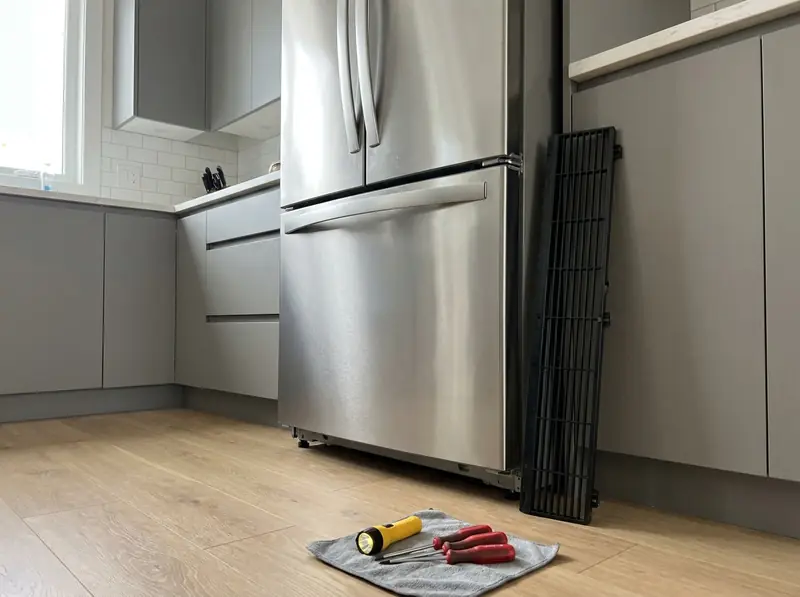
- Condenser coils. On most models they are behind the lower front grille or on the back. If they are matted with dust and pet hair, unplug the unit and vacuum them. Dirty coils are a very common cause of a fridge that struggles in a warm kitchen.
If the refrigerator still does not cool after those, the fault is internal and worth a professional visit.
What are the common causes?
Evaporator fan failure
The evaporator fan sits in the freezer compartment and pushes cold air over the coil and into the fresh-food section. When it fails, the freezer often stays cold while the fridge warms. You may hear nothing from the freezer when the door is open and the compressor is running, or a grinding noise if the blades are hitting frost. A technician confirms it by checking the motor for voltage and spin, and replaces the motor assembly.
Defrost system failure
Frost-free refrigerators melt the frost off the evaporator coil several times a day using a heater, a defrost thermostat and a timer or control board. If any of those fail, frost builds into a block of ice that stops air moving. Symptoms are a fridge that slowly warms over days, a freezer back wall caked with frost, and sometimes water on the floor. The technician removes the back panel of the freezer, finds the iced coil, tests the heater and thermostat, and replaces the failed part.
Dirty or blocked condenser coils
The condenser coils dump heat from the refrigerant. Coated in dust, they cannot, and the compressor runs hot and constantly without reaching temperature. Cleaning is the fix; if the unit has been running that way for a long time the compressor may have been damaged, which the technician checks by measuring how well it pulls down temperature after cleaning.
Condenser fan or start relay
The condenser fan cools the coils and compressor at the bottom rear. If it stops, the compressor overheats and shuts off on its thermal protector, then tries again: a clicking every few minutes. A failed start relay produces the same clicking without the fan being at fault. Both are inexpensive parts and quick repairs.
Compressor or sealed-system fault
If the compressor runs but neither compartment gets cold, and the coils and fans are fine, the problem is inside the sealed system: a weak compressor, a refrigerant leak or a restriction. This is the expensive end of refrigerator repair and requires a technician with EPA Section 608 certification. On a unit older than about ten years, this is usually the point where replacement makes more sense, which the repair-or-replace guide explains.
Appliance down right now? One call and we will get it fixed.
When is it worth repairing?
Fan motors, defrost parts, relays, thermistors and gaskets are worth repairing on almost any refrigerator that is otherwise in good shape; these jobs land in or below HomeAdvisor's Fairfax average of about $204. A compressor or sealed-system job on a refrigerator past ten years is usually not. A good technician gives you the quote and the age-based advice together.
What will the technician do?
Expect them to ask when it started, whether the freezer is also warm, and whether you hear the compressor. They will check the coils and fans, pull the freezer back panel to inspect the evaporator for frost, test the defrost components and fan motors with a meter, and measure temperatures.
Read the full answer
Most diagnoses take under an hour. If a part is on the truck, the repair happens the same visit; otherwise it is ordered and fitted on a return trip.
Fridge not cooling in Fairfax? Call before the food goes.
Call Jem and get your appliance repaired at home, across Fairfax County, VA and the wider DC area. Monday to Saturday, 8am to 8pm. $90 diagnostic, 90-day warranty on parts and labor.