Appliance repair · Fairfax County, VA
Dryer Not Heating: Likely Causes and What to Do
Jem repairs refrigerators, washers, dryers, ovens and dishwashers at your home across Fairfax County. Call and he'll get yours fixed.
- 6 years hands-on
- $90 diagnostic
- 90-day parts & labor warranty
- Mon–Sat 8am–8pm
Quick answer
A dryer that runs but does not heat has a failed heating element, thermal fuse or thermostat (electric), a failed igniter, gas valve coils or flame sensor (gas), or a 240-volt breaker with one tripped leg. A lint-blocked vent is often the cause behind the blown fuse. Check the breaker and vent, then call (571) 306-9390.
Updated 2026-11-12 · Serving Fairfax County, VA
"Runs but no heat" is the single most common dryer complaint and one of the most repairable. This page, from our dryer repair section, separates electric from gas dryers and explains how a technician tells the causes apart.
Is it safe to check anything yourself?
A few things, and nothing involving the gas line or the heater box.
- Breaker (electric dryers). Electric dryers use a double 240-volt breaker. If one half trips, the motor still runs on 120 volts but the element gets nothing. Switch the double breaker fully off and back on.
- Vent. Clean the lint screen. Go outside and check that the vent flap opens when the dryer runs. A vent that barely breathes overheats the dryer and blows the thermal fuse.
- Settings. Make sure the cycle is not "air fluff" or "no heat".
- Gas supply (gas dryers). Confirm the gas shut-off valve behind the dryer is open. If you smell gas at any point, stop: leave the house, call 911, then the Washington Gas Emergency Leak Line at 844-WASHGAS (844-927-4427), option 1.
Do not bypass a thermal fuse or open the burner assembly yourself. The fuse blew for a reason.
What are the common causes: electric dryers?
Heating element
A coil of resistance wire inside a metal housing at the back or bottom of the cabinet. Over years the wire breaks. The dryer runs normally with cold air. A technician checks the element for continuity and replaces it; the element is one of the cheaper dryer parts.
Thermal fuse
A one-time safety fuse that opens when the exhaust gets too hot, almost always because the vent is restricted. On many models an open fuse stops heat; on others it stops the motor too. It must be replaced, not bypassed, and the vent problem that blew it must be fixed or it will blow again.
High-limit and cycling thermostats
Two thermostats regulate the heater. A failed high-limit thermostat kills heat entirely; a failed cycling thermostat produces no heat or runaway heat. Both are tested with a meter and swapped quickly.
A tripped leg of the 240-volt circuit
Covered above. If resetting the breaker fixes it and it trips again, the element may be shorted to its housing, which the technician checks.
Appliance down right now? One call and we will get it fixed.
What are the common causes: gas dryers?
Igniter
A glow bar that heats until the gas valve opens. When it cracks or weakens it may glow and then stop without the burner lighting. The technician watches the burner through the inspection panel during a cycle: no glow means igniter or a circuit upstream of it.
Gas valve coils
Two or three small electromagnetic coils open the gas valve once the igniter is hot. Weak coils open briefly then fail, so the dryer heats for the first few minutes and then runs cold. This pattern (warm, then cold) is the signature of coil failure.
Flame sensor
Confirms the igniter is hot enough before gas flows. A failed sensor means the igniter never glows. Tested for continuity and replaced.
Thermal fuse
Same part and same vent cause as on electric dryers.
When is it worth repairing?
Almost always. Elements, fuses, thermostats, igniters, coils and sensors are low-cost parts, so these jobs usually fall at or below the Fairfax average appliance repair of $204 that HomeAdvisor reports. The NAHB gives dryers about a 13-year life; even near that mark a no-heat repair is normally worth it unless the drum or motor is also failing.
See the repair-or-replace guide for the edge cases.
What will the technician do?
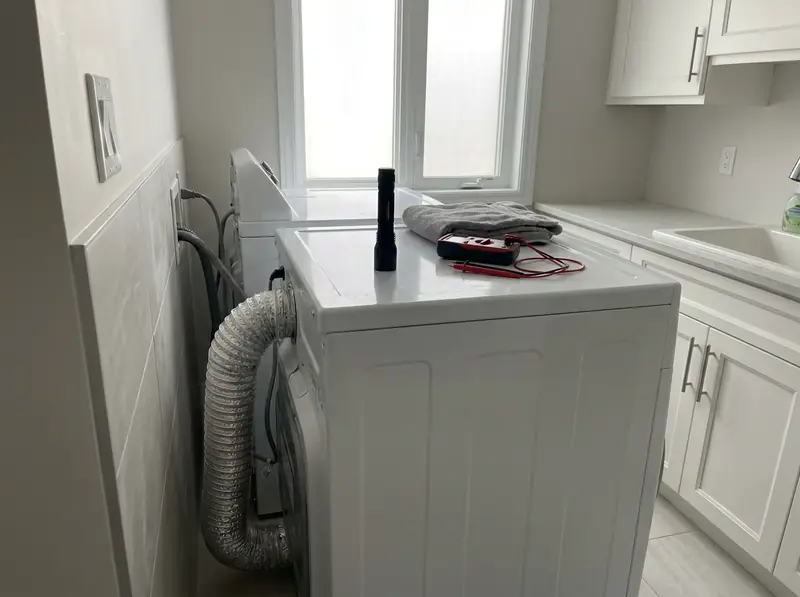
They will confirm electric or gas and check supply first, then open the cabinet and test the element or burner circuit part by part with a meter: fuse, thermostats, element or igniter, coils and sensor. They will also check the internal lint path and the blower housing, because a blocked path is what killed the fuse.
Most no-heat repairs are finished in a single visit with parts from the truck.
Dryer cold? Get it fixed.
Call Jem and get your appliance repaired at home, across Fairfax County, VA and the wider DC area. Monday to Saturday, 8am to 8pm. $90 diagnostic, 90-day warranty on parts and labor.